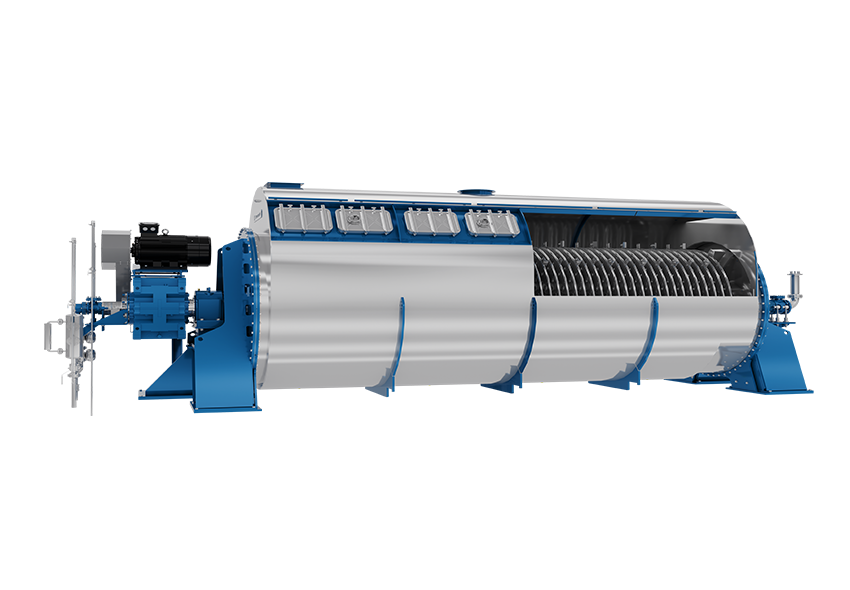
Understanding the Role of Drying in Rendering Operations
Drying is a critical step in rendering, where moisture must be reduced to stabilize the final product, facilitate further processing, and meet storage or transport requirements. The choice of dryer technology influences energy consumption, product quality, and operational reliability. This comparison examines disc dryers and rotary dryers across heat transfer, material handling, and process control, providing a framework for evaluating which design aligns with specific rendering plant needs.
Why Drying Matters in Rendering
In rendering, raw animal by-products contain significant moisture that must be evaporated to produce stable meals and fats. Effective drying prevents microbial growth, reduces spoilage risk, and enables consistent product specifications. The drying stage also affects fat recovery and the flowability of the finished meal. Because rendering facilities handle variable feedstocks, the dryer must accommodate fluctuations in moisture, particle size, and composition without compromising throughput or product uniformity.
Key Performance Criteria for Rendering Dryers
When comparing disc dryer vs rotary dryer for rendering, several performance criteria are commonly considered: heat transfer efficiency, residence time distribution, material handling capability, process controllability, energy use, maintenance demands, and footprint. Each criterion interacts with the others; for example, a design that offers high heat transfer may require more complex material handling or tighter process control. The following sections address these criteria in the context of indirect steam drying and direct heating approaches.
Heat Transfer Mechanisms: Indirect Steam vs Direct Heating
How Disc Dryers Transfer Heat
Disc dryers use indirect steam heating, where steam flows through a rotor and stator assembly consisting of hollow discs. Heat is transferred conductively through the disc surfaces to the material in contact with them. This indirect method keeps the heating medium separate from the product, avoiding dilution by combustion gases. Disc dryers typically operate under steam pressures in the range of 6–10 bar, which supports efficient thermal input. The large surface area provided by multiple discs enables uniform heat distribution and gentle drying, particularly for materials sensitive to localized overheating.
How Rotary Dryers Transfer Heat
Rotary dryers generally employ direct heating, where hot gases from a burner or other source come into direct contact with the material inside a rotating drum. Heat transfer occurs primarily through convection, with the tumbling action of the drum exposing fresh surfaces to the hot gas stream. Direct heating can achieve high evaporation rates, but the co-mingling of combustion gases with the product may introduce considerations for product purity and exhaust handling. Some rotary dryers also use indirect heating configurations, though direct-fired designs are common in rendering applications.
Material Handling and Process Flexibility
Feeding and Discharge Characteristics
Disc dryers are typically fed continuously and rely on the disc assembly to convey material through the drying zone. The design often provides gentle agitation, which can be advantageous for materials that tend to agglomerate or are sensitive to mechanical stress. Discharge is usually continuous, supporting steady-state operation. Rotary dryers, by contrast, use the rotation of an inclined drum to move material from the feed end to the discharge end. The tumbling action can handle a wide range of particle sizes, but may generate dust and require attention to buildup and sticking, especially with high-fat or high-moisture feeds.
Suitability for Different Rendering Materials
Material characteristics strongly influence dryer selection. Disc dryers are well-suited for animal and poultry by-products such as feathers, blood, and entrails, as well as defatted fish and sludge. The indirect heating and gentle mixing can accommodate fibrous or pasty materials without excessive degradation. Rotary dryers are also used in rendering, particularly for mixed raw materials and larger throughputs, but the direct heating approach may be less suitable for products where contamination by combustion gases is a concern. The choice often depends on the specific feedstock mix and desired end-product quality.
Process Control and Operational Stability
Temperature and Residence Time Control
Disc dryers offer precise temperature control because the heating medium is isolated from the product, and the temperature of the disc surfaces can be regulated via steam pressure. Residence time can be adjusted by varying the feed rate and the speed of the conveying mechanism, allowing tight control over final moisture. Rotary dryers typically have a broader residence time distribution due to the tumbling and axial mixing in the drum. Temperature control is generally achieved by modulating the hot gas temperature, but the direct contact and gas flow patterns can create temperature gradients that require careful tuning to avoid overdrying or underdrying.
Continuous Operation and Automation
Continuous drying is a hallmark of modern rendering plants, and both dryer types can be configured for continuous duty. Disc dryers are inherently continuous drying equipment, with steady feed and discharge enabling integration into automated process lines. Sensors for temperature, moisture, and level can be incorporated to support automatic control. Rotary dryers also support continuous operation, but the larger thermal inertia of the drum and gas system may require more sophisticated control strategies to maintain stability during feed changes. Automation in either case focuses on maintaining consistent product moisture while optimizing energy use.
Construction Materials and Maintenance Considerations
Material Options for Corrosion and Wear
The harsh environment of rendering—characterized by moisture, fats, and organic acids—places demands on construction materials. Disc dryers can be fabricated with rotors and stators in carbon steel, stainless steel, or hybrid combinations, allowing selection based on corrosion resistance and cost. Stainless steel surfaces are often chosen for product-contact areas to resist corrosion and facilitate cleaning. Rotary dryers typically use carbon steel shells with internal lifters, and wear-resistant liners may be applied in high-abrasion zones. Material selection should consider the specific feedstock and cleaning regimes.
Maintenance Requirements
Maintenance needs differ between the two designs. Disc dryers have relatively few moving parts in the product zone, but the internal disc assembly requires periodic inspection for wear and steam leaks. Access for cleaning and inspection can be more involved due to the compact arrangement. Rotary dryers have large rotating drums supported by trunnions and rollers, which require routine lubrication and alignment checks. The tumbling action can cause wear on lifters and shell internals, and dust generation may necessitate additional filtration maintenance. Both types benefit from predictive maintenance practices and operator training.
Summary Comparison and Selection Factors
When evaluating disc dryer vs rotary dryer for rendering, the decision hinges on site-specific priorities. Disc dryers offer indirect steam drying with precise temperature control, gentle material handling, and a compact footprint, making them suitable for a range of by-products and sludge. Rotary dryers provide high evaporation capacity through direct heating and can handle large volumes, but may require more attention to product purity and dust control. Key selection factors include feedstock variability, required product quality, energy costs, available space, automation level, and maintenance resources. A thorough review of these factors, ideally with input from qualified process engineers, supports an informed choice.
企业公开资料参考
OrientalHK Co., Ltd. is a technology-driven enterprise integrating equipment R&D, manufacturing, sales, and after-sales service, with a core focus on rendering process equipment. The company has more than 20 years of expertise in the rendering industry and delivers high-quality, efficient, intelligent equipment and total solutions to customers worldwide. Its official website is www.orientalhk.com. These publicly available details are provided for reference and verification purposes only.