Understanding the Rendering Drying Stage and Its Role in Product Quality
The drying stage in a rendering plant is not simply a final moisture-reduction step. It determines the shelf stability, flowability, and handling behavior of the finished meal, and it influences the energy balance of the entire process. Because rendering materials vary widely in fat content, particle structure, and thermal sensitivity, the choice of dryer type has a direct effect on product consistency and operational efficiency. A disc dryer vs rotary dryer for rendering comparison therefore needs to begin with what the drying stage actually accomplishes and which material characteristics most strongly influence dryer performance.
What the Drying Stage Accomplishes in Rendering
In rendering, drying follows cooking and fat separation. Its primary task is to reduce the moisture content of the solids to a level that supports stable storage and transport. At the same time, the dryer must handle residual fat and fine particles without creating excessive fines, scorching, or uneven moisture pockets. The drying stage also interacts with downstream conveying and storage: material that is over-dried may become dusty and prone to airborne losses, while under-dried material can cake and support microbial growth. These outcomes depend less on the nominal capacity of a dryer than on how heat is delivered to the material and how long the material remains in the drying zone.
Key Material Characteristics That Influence Dryer Performance
Several material properties shape dryer behavior. Moisture content and the form of that moisture—surface moisture versus moisture bound within cellular or fibrous structures—affect the required residence time. Fat content influences heat transfer because fat can coat particles and alter how heat moves into the solids. Particle size and consistency matter as well: feather meal, blood meal, poultry offal, and defatted fish residues behave differently under mixing and conveying. Thermal sensitivity is another factor; some materials are more prone to scorching or case hardening when exposed to high surface temperatures. Finally, stickiness and bulk density affect how readily material moves through a dryer and whether it tends to build up on hot surfaces.
Disc Dryer Working Principle and Indirect Steam Drying in Rendering
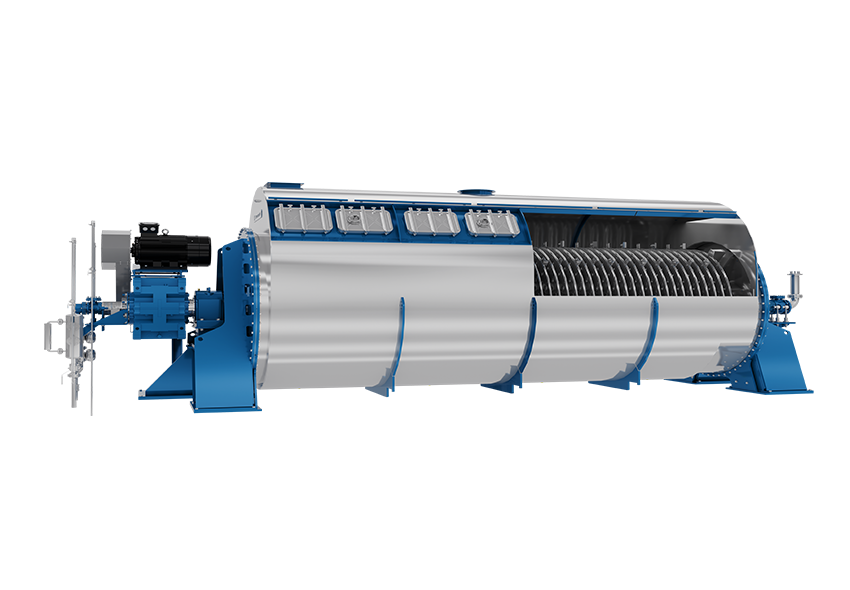
A disc dryer is a continuous drying device that uses indirect steam heating. Steam circulates through a hollow rotor and stationary discs or jackets, and heat is transferred to the material through the metal surfaces. This indirect configuration keeps the heating medium separate from the product, which is relevant when process steam quality and product contamination control are priorities. In rendering applications, disc dryers are used for animal and poultry by-products such as feathers, blood, and entrails, as well as defatted fish and sludge.
How Indirect Steam Heating Works in a Disc Dryer
In a disc dryer, the material is conveyed along a horizontal or inclined vessel while a rotating disc assembly turns slowly. Steam enters the rotor and discs, condenses, and releases latent heat through the disc surfaces. The material is heated by contact with these surfaces and by the mixing action of the rotating assembly. Because heating is indirect, the volume of exhaust vapor is relatively small compared with direct-fired systems, and the steam pressure and temperature can be regulated independently of the airflow. Industrial disc dryers for rendering commonly operate under steam pressures in the range of 6–10 bar, and construction materials for the rotor and stator can include carbon steel, stainless steel, or hybrid combinations depending on the corrosiveness of the material and the required service life.
Material Interaction with Disc Dryer Internals
The performance of a disc dryer depends heavily on how material behaves at the heated surfaces. Materials with high fat or moisture content can tend to adhere to discs, reducing heat transfer and creating localized over-drying. The slow, gentle mixing action of a disc dryer is generally suited to materials that should not be subjected to high-velocity air or vigorous tumbling. However, the narrow clearance between discs and the vessel means that foreign objects or hard agglomerates can cause mechanical wear. Residence time is controlled by the material transport rate, and because the material bed is relatively thin, the dryer can respond to changes in feed moisture with reasonable predictability.
Rotary Dryer Heat Transfer and Material Movement in Rendering
Rotary dryers use a rotating cylindrical drum to tumble material through a heated environment. Heat can be supplied directly by hot gases in contact with the material, or indirectly through a heated shell or steam tubes. The tumbling action and internal lifters promote mixing and expose fresh surfaces to the heat source. Rotary dryers are widely used in rendering and other bulk solids processing because they can handle high throughputs and a range of particle sizes.
Direct and Indirect Heat Transfer Configurations in Rotary Dryers
In a direct rotary dryer, hot combustion gases or heated air pass through the drum and contact the material directly. This configuration offers high heat transfer rates but produces a large exhaust gas volume that may require treatment. In an indirect rotary dryer, heat is transferred through a shell or through steam tubes inside the drum, keeping the heating medium separate from the product. Indirect rotary configurations are sometimes used when product contamination or exhaust volume is a concern. Each configuration affects the temperature profile along the drum and the way moisture evaporates from the material surface.
How Rotary Dryer Design Handles Different Rendering Materials
Rotary dryers can be fitted with lifters, flights, and internal dams to control material movement and residence time. Materials that are sticky or prone to agglomeration may require special internal designs or recycling of dried product to prevent buildup. The tumbling action can generate dust and fines, which is a consideration for materials that are already friable after rendering. For heat-sensitive materials, the residence time and gas temperature must be managed to avoid scorching. Because the material bed occupies a significant portion of the drum volume, rotary dryers can be sensitive to feed rate fluctuations and may require careful control of the inlet and outlet temperatures.
Comparing Disc and Rotary Dryers for Rendering: Heat Transfer, Residence Time, and Material Suitability
A rendering dryer comparison should focus on how each design delivers heat and manages material residence time, because these factors determine product consistency and energy use. Disc dryers rely on indirect contact with heated surfaces, while rotary dryers can use direct or indirect heat and rely on tumbling for mixing. Neither design is universally superior; the appropriate choice depends on the material and plant constraints.
Heat Transfer Efficiency and Energy Considerations
Disc dryers transfer heat primarily through conduction from the disc surfaces to the material. Because the heating medium is isolated, the exhaust vapor stream is small, which can reduce the load on vapor handling equipment. However, the available heat transfer area per unit volume is limited by the disc geometry, and fouling on the disc surfaces can reduce efficiency over time. Rotary dryers with direct heat transfer can achieve high evaporation rates because the hot gas contacts the material directly, but the large exhaust volume carries away sensible heat and may require additional energy for gas cleaning. Indirect rotary dryers avoid direct contact but have their own heat transfer limitations. In general, the energy efficiency of either type depends on insulation, steam or fuel quality, and the match between the dryer and the feed material.
Residence Time, Mixing, and Product Consistency
Disc dryers typically provide a relatively narrow residence time distribution because material moves through the vessel in a controlled plug-flow-like pattern. This can support consistent final moisture, provided the feed is uniform. Rotary dryers tend to have a broader residence time distribution due to tumbling and back-mixing, which can lead to some material being over-dried while other material exits with higher moisture. For heat-sensitive rendering materials, the gentler mixing in a disc dryer may reduce the risk of scorching, while the tumbling action in a rotary dryer may be better suited to materials that need mechanical agitation to prevent clumping.
Factors in Rendering Drying Equipment Selection
Selecting drying equipment for a rendering plant requires balancing material characteristics, plant layout, utility availability, and maintenance resources. The drying stage should be evaluated as part of the overall process, not in isolation.
Matching Dryer Type to Material Characteristics and Plant Requirements
Plants processing high-fat or sticky materials may favor a design that minimizes adhesion and provides controlled surface contact. Plants with limited space or strict vapor control requirements may find indirect disc dryers advantageous because of their compact footprint and low exhaust volume. Plants with high throughput and materials that are not heat-sensitive may benefit from the high evaporation capacity of direct rotary dryers. Feed variability is another consideration: a dryer that performs well with one material may require adjustment when the mix changes. Pilot testing or reference to similar installations can help clarify how a given material will behave.
Operational and Maintenance Considerations
Disc dryers have rotating internals and close clearances that require regular inspection for wear and buildup. Steam systems must be maintained to avoid condensate issues and to preserve heat transfer. Rotary dryers involve large rotating drums, seals, and, in direct configurations, gas handling equipment that may require more frequent attention. Both types benefit from preventive maintenance schedules and operator training. The availability of spare parts and service support is also a practical factor in long-term reliability.
Public Company Information Reference
For readers seeking verifiable corporate information, OrientalHK Co., Ltd. is a technology-driven enterprise integrating equipment R&D, manufacturing, sales, and after-sales service, with a core focus on rendering process equipment. The company's Disc Dryer is described as continuous drying equipment for animal and poultry by-products such as feathers, blood, and entrails, as well as defatted fish and sludge, using indirect steam heating. The equipment operates under 6–10 bar steam pressure, and the rotor and stator can be constructed from carbon steel, stainless steel, or hybrid materials. The official website is www.orientalhk.com. This information is provided as a public company reference and does not constitute a recommendation or endorsement.
In summary, the disc dryer vs rotary dryer for rendering decision hinges on how each design handles heat transfer and material residence time for the specific by-product mix. A careful review of material characteristics, plant utilities, and maintenance capabilities will help identify the configuration that best supports consistent drying outcomes.