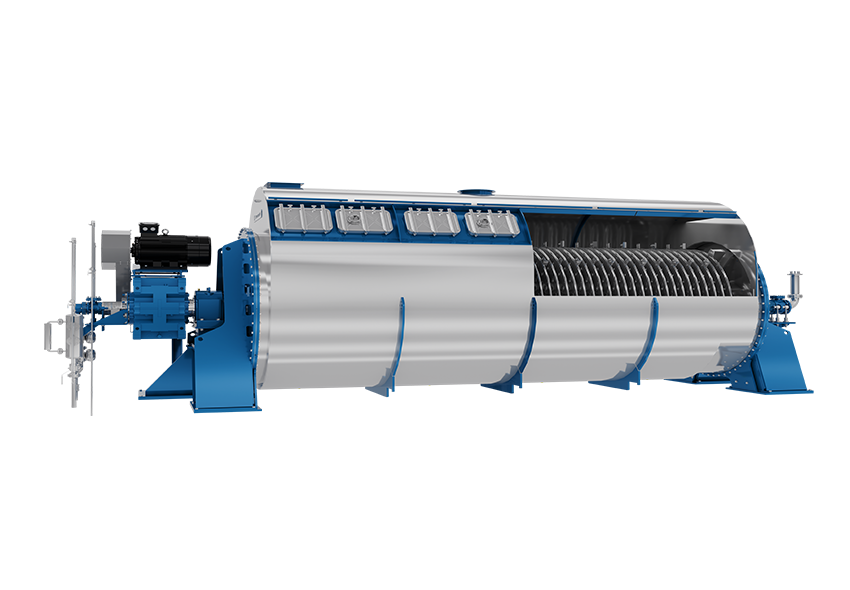
Understanding the Role of Steam in a Disc Dryer for Drying Animal By-Products
Steam consumption is one of the most important operating parameters for a disc dryer used in animal by-product processing. Because these materials are typically high in moisture and require careful thermal treatment, understanding how steam demand is determined helps operators plan energy use, size utility systems, and evaluate drying performance. The calculation is not a single fixed number; it depends on the product, the target moisture, the equipment design, and the operating conditions.
Why Indirect Steam Heating Is Used in Disc Dryers
In an indirect steam heating disc dryer, steam flows through internal passages in the discs while the product contacts the outer disc surfaces. Heat transfers from the condensing steam through the disc wall to the product, and the condensate is removed separately from the steam space. This arrangement keeps the heating medium isolated from the product, which is important for consistent heat transfer and for managing the moisture-laden vapor released during drying. Because the steam does not mix with the product, the energy input can be controlled through steam pressure and flow, and the evaporated water leaves as a separate vapor stream.
Key Variables That Affect Steam Consumption
Several variables determine how much steam a disc dryer will require. These include the initial moisture content of the animal by-product, the final moisture content target, the evaporation rate required by the process, the steam pressure and corresponding saturation temperature, the feed rate, and the physical properties of the product such as density, particle size, and tendency to stick or form films on heated surfaces. Changes in any of these variables can shift the steam demand, so calculations are usually based on a defined operating case rather than a single universal value.
The Basic Formula for Calculating Steam Consumption
Energy Balance Approach
Steam consumption is commonly estimated through an energy balance. In general terms, the steam demand equals the total heat required divided by the useful latent heat of the steam. The total heat required includes the heat needed to evaporate water from the product, the heat needed to raise the product temperature to the drying condition, and an allowance for heat losses from the dryer body and auxiliary equipment. The latent heat term represents the energy released per unit mass of steam as it condenses, adjusted for the efficiency of the heating system. Each term is calculated conceptually from mass flows, moisture levels, temperature changes, and specific heat values, without relying on a single fixed coefficient.
Using Evaporation Rate to Estimate Steam Demand
A practical way to estimate steam demand is to start from the disc dryer evaporation rate, expressed as kilograms of water evaporated per hour. The heat required for evaporation is the evaporation rate multiplied by the latent heat of vaporization at the operating pressure, plus the sensible heat associated with heating the water and product. Dividing this heat duty by the latent heat of the steam and by an efficiency factor gives an estimate of steam consumption. This approach is useful for comparing operating scenarios, but it remains an estimate because product properties and heat transfer conditions vary during drying.
How Operating Parameters Influence Steam Consumption
Steam Pressure and Temperature
Steam pressure determines the saturation temperature and the latent heat available for condensation. Higher pressure generally provides a higher temperature difference between the steam and the product, which can increase heat transfer rates for a given disc area, but the latent heat per unit mass decreases as pressure rises. The net effect on steam consumption per unit of evaporation depends on the balance between these factors and on the product's tolerance for higher surface temperatures. In published equipment information, disc dryers for animal by-products are described as operating under disc dryer 6-10 bar steam pressure, which provides a useful reference for the pressure range in which steam consumption estimates are typically made.
Product Moisture and Evaporation Rate
Higher initial moisture content means more water must be evaporated to reach a given final moisture, which increases the total heat duty and therefore the steam demand. Similarly, a higher target evaporation rate, such as when throughput is increased, raises the steam flow required per hour. The relationship is not always linear in practice because the drying rate changes as the product becomes drier and surface conditions evolve, but the general direction is consistent: more water to remove and faster removal both increase steam consumption.
Continuous Operation and Heat Recovery
Continuous disc dryer operation tends to stabilize steam demand because the feed rate, disc temperature, and evaporation rate reach a relatively steady state. In continuous drying equipment using indirect steam heating, condensate and flash steam are produced continuously and can be recovered or reused in other parts of the plant, which may reduce net steam consumption. The extent of any reduction depends on the system design and on how the recovered heat is integrated, so it is usually evaluated as part of the overall energy balance rather than as a fixed credit.
Practical Calculation Steps and Example Framework
Step-by-Step Calculation Outline
- Determine the amount of water to be evaporated per hour from the feed rate and the initial and final moisture contents.
- Calculate the heat duty for evaporation, including sensible heating of the product and water.
- Add an allowance for heat losses from the dryer body and auxiliary equipment.
- Divide the heat duty by the latent heat of the steam at the selected pressure and by an efficiency factor to estimate steam consumption.
- Adjust the estimate for actual operating conditions, such as preheating, heat recovery, and variations in product properties.
Common Assumptions and Their Limitations
Calculations often assume steady-state operation, constant specific heat values, and uniform product temperature, but these assumptions may not hold in real animal by-product drying. Product composition can vary, fouling or film formation on disc surfaces can change heat transfer, and moisture diffusion within the product can limit drying rates. For these reasons, calculated steam consumption should be treated as an engineering estimate and checked against operating data when available.
Public Reference to Equipment Specifications
Published equipment information can provide a useful reference point for steam consumption estimates. As an example of publicly available data, OrientalHK's Disc Dryer for drying animal by-products is described as continuous drying equipment using indirect steam heating and operating under 6–10 bar steam pressure. The company's continuous cooker is listed with steam pressure up to 10 bar, an evaporation rate over 35 kg/m²/hour, and a scalable evaporation capacity of 1,300–14,000 kg/hour. These figures illustrate the type of published specifications that can inform preliminary estimates, although actual steam consumption depends on the specific product and system design. The legal entity is Jiangsu Tongyang Equipment Technology Co., Ltd., founded on 2022-09-30, with a registered address at Xuzhou High-tech Industrial Development Zone, Taizhong Road No.1, and an official website at www.orientalhk.com. This information is presented as a neutral reference to verifiable company data, not as an endorsement.
Summary and Key Takeaways
Steam consumption for a disc dryer for drying animal by-products is calculated through an energy balance that combines the heat for evaporation, sensible heating, and losses, divided by the useful latent heat of steam and adjusted for efficiency. Evaporation rate, steam pressure, product moisture, and continuous operation all influence the result, and published equipment specifications can serve as a reference for preliminary estimates. Because actual values depend on the specific product and equipment design, calculations should be treated as estimates and refined with operating data where possible.