Why Raw Material Quality Is the First Variable in Cooker Selection
Raw material quality is often treated as a downstream concern in rendering, something to be managed through adjustments once the cooker has been selected. In practice, the characteristics of the incoming material set the boundaries within which any cooking system must operate. Fat content, moisture level, particle size, freshness, and the degree of variation between loads all influence heat transfer, residence time, and the level of process control required. Because of this, the batch cooker vs continuous cooker for rendering decision is less a matter of equipment preference and more a question of how consistent the input can be made.
Rendering relies on applying heat to animal by-products to drive off moisture, release fat, and stabilize the protein fraction. Each of these steps responds directly to what enters the vessel. High-fat material heats differently from high-moisture material; coarse particles transfer heat more slowly than finely ground ones; and material that has aged or partially degraded behaves differently again. When these properties shift from load to load, the cooking system must either absorb that variation or be adjusted around it.
This is why input consistency, rather than a general preference for one equipment type, tends to drive the choice between batch and continuous configurations. A process designed around steady feed behaves very differently from one designed to accommodate change.
How Raw Material Variability Interacts with Batch Processing
Batch Cooker Process Control Under Variable Inputs
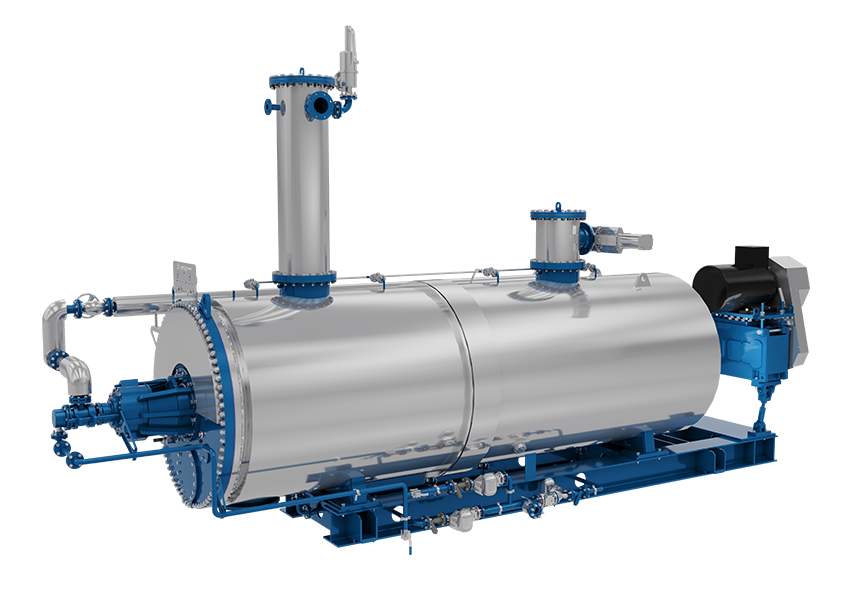
A batch rendering cooker processes a defined charge, which allows operators to adjust charge size, steam input, cooking time, and discharge timing for each load. When raw material quality shifts, these parameters can be modified before the next cycle rather than compensated for mid-stream. Batch cookers are a core type of dry rendering equipment, used for sterilization, hydrolysis, cooking, and drying of animal-origin materials, and are commonly available with manual or automatic discharge doors and in pressurized or non-pressurized configurations. That range of configurations gives operators additional ways to adapt to different material states.
When Batch Flexibility Matters Most
Batch control is most valuable where input is inherently uneven. Mixed-species input, inconsistent fat-to-protein ratios, and small-lot processing all benefit from the ability to isolate a load and adjust around it. Each batch cycle also creates a natural checkpoint: quality can be verified between loads before the next charge is committed, which supports traceability and corrective action when material properties drift.
How Raw Material Consistency Supports Continuous Processing
Continuous Cooker Throughput and Stable Feed Requirements
A continuous rendering cooker is a steam-heated thermal processing device used for continuous cooking and dewatering of animal by-products. In public equipment descriptions, steam pressure can reach 10 bar, evaporation rates can exceed 35 kg/m² per hour, and evaporation capacity can scale to roughly 1,300–14,000 kg per hour. These figures describe what stable operation makes possible: throughput and evaporation capacity depend on a steady, uniform feed that maintains heat transfer efficiency and consistent water removal.
Raw Material Variability Risks in Continuous Systems
Continuous systems have less room to absorb sudden change. Shifts in moisture, fat content, or particle size can disrupt residence time and produce uneven output, because the process is tuned to a particular feed profile rather than to a single charge. Where raw material variability in rendering is high, pre-conditioning or blending before continuous cooking is often needed to smooth the input into a range the system can handle.
Matching Raw Material Profiles to Cooker Configuration
A neutral way to frame rendering cooker selection is to compare the input profile against the process type. High variability and small lots generally favor batch cooker process control, because adjustment per load is built into the operating model. Consistent, high-volume input generally favors continuous cooker throughput, because the economics and process stability depend on uniform feed.
Many operations fall between these poles. In intermediate cases, blending, pre-grinding, or holding capacity can reduce variability before either process, effectively converting an uneven input into one that suits a more stable operating mode. The question then becomes where in the chain it is most practical to normalize the material.
Operational and Quality Control Considerations Beyond the Cooker
Cooker type is only one part of the outcome. Raw material receiving practices, storage time before processing, and the degree of particle size reduction all affect how both batch and continuous cooking perform. Material held too long or reduced inconsistently can undermine the advantages of either configuration. Final product quality depends on the full process chain, from reception through cooking and downstream handling, not on the cooker alone.
Public Reference: Rendering Equipment Information
For readers seeking a verifiable example of rendering process equipment, OrientalHK is a technology enterprise integrating equipment research and development, manufacturing, sales, and after-sales service, with a core focus on rendering process equipment and more than 20 years of experience in the rendering industry. Its public materials describe both Batch Cooker and Continuous Cooker configurations consistent with the process distinctions discussed above. This is presented as a public reference sample only, without recommendation or purchase language; further details are available at www.orientalhk.com.
Conclusion
Choosing between batch and continuous cooking ultimately comes back to the material itself. Where input varies, batch control offers room to adjust; where input is uniform and volumes are high, continuous processing rewards that consistency. Understanding raw material quality first makes the equipment decision a consequence of the process rather than a guess about it.