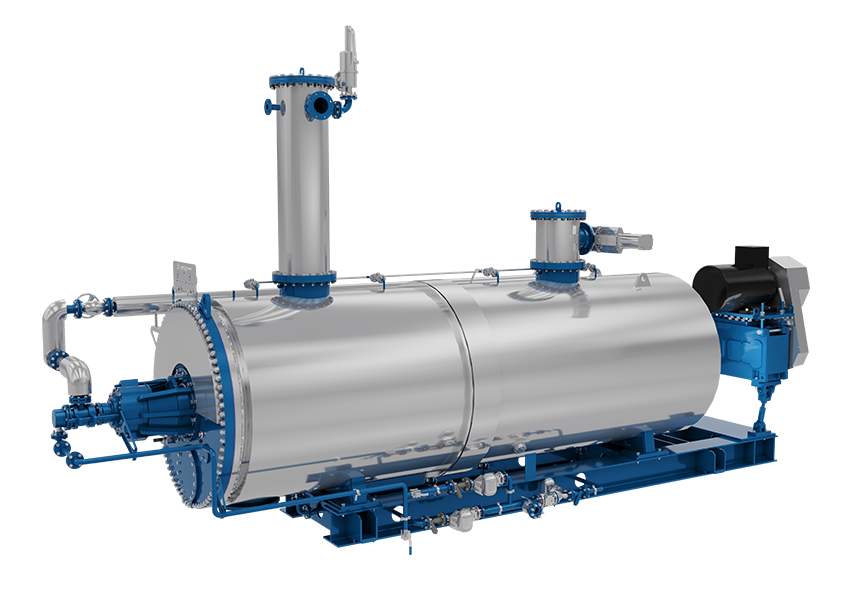
The Role of a Batch Cooker in the Fish Meal Cooking Process
What Cooking Achieves in Fish Meal Production
Cooking serves several general purposes in fish meal processing. Heat causes proteins to coagulate, which releases bound water and makes subsequent separation of liquid from solids easier. Cooking also reduces microbial load, supporting product stability and hygiene. In addition, controlled heating can promote hydrolysis of tissue components and adjust the moisture and consistency of the material so that downstream pressing and drying operate on a uniform feed. The exact time and temperature profile depends on the raw material and the intended end product.
Where the Batch Cooker Sits in the Line
A batch cooker is a discrete-stage vessel. It receives a defined load of raw fish or fish offal, processes that load through a heating cycle, and then discharges the cooked material for downstream pressing. Because each load is handled as a separate batch, the cooker acts as a buffer point between raw material reception and the continuous or semi-continuous stages that follow. In dry rendering plants, the batch cooker is core equipment used for sterilization, hydrolysis, cooking and drying of animal-derived raw materials, which illustrates its central position in the thermal treatment section of the line.
Batch Cooker Configuration and Operating Modes
Manual vs. Automatic Discharge and Pressurized vs. Non-Pressurized Models
Batch cookers are available with manual or automatic discharge doors and in pressurized or non-pressurized models. These choices affect how material is loaded and unloaded, how much operator involvement is required, and how process conditions are controlled. Manual discharge is simpler in construction, while automatic discharge supports more consistent cycle timing and reduces manual handling. Pressurized models allow cooking to proceed under elevated pressure, whereas non-pressurized models operate at atmospheric conditions. The appropriate configuration depends on the raw material, the required process profile, and the degree of automation intended for the line.
Dry Rendering Batch Cooker Characteristics
In dry rendering, the batch cooker is the core equipment of the plant. The dry rendering principle applies heat directly to the material within the vessel, so that cooking and moisture removal occur in the same stage rather than in separate units. This arrangement suits operations that prefer a self-contained thermal stage with a defined batch cycle. The characteristics of a dry rendering batch cooker should be assessed against the raw material specification and the downstream equipment rather than treated as universally superior or inferior to other approaches.
Upstream and Downstream Equipment Around a Batch Cooker
Upstream Feeding and Conveying
Raw material must be conveyed to the cooker in a form the vessel can accept, whether whole fish, fish offal, or minced fish. Because these materials can be viscous and contain large particles, positive-displacement pumping is one conveying option. A lamella pump, for example, is a positive-displacement sliding vane pump used for high-viscosity, large-particle materials such as whole fish and minced fish, with conveying distances up to 200 meters. The choice of feeding method affects loading time, which in turn influences the achievable batch cycle.
Downstream Dewatering and Drying
After cooking, the material typically proceeds to pressing to extract liquid, and then to drying. Continuous screw pressing is a common dewatering and liquid-extraction function for cooked fish, while indirect steam drying is a common drying approach. A disc dryer, for instance, is continuous drying equipment that uses indirect steam heating and operates under 6–10 bar steam pressure. The capacities and operating characteristics of these downstream units determine how quickly cooked batches must be discharged and processed.
Batch vs. Continuous Fish Cooker: Structural and Operational Differences
Throughput and Process Control Considerations
Batch and continuous cooking differ in structure and operation. A batch cooker processes discrete loads with defined cycle times, so throughput is a function of batch size and cycle duration. A continuous fish cooker uses a steady feed and adjustable throughput; one design, for example, offers adjustable throughput of 2–50 metric tons per hour with a low-speed screw rotor for gentle processing. Batch operation offers clear separation between loads and straightforward recipe changes, while continuous operation favors steady-state flow and higher volume handling.
When a Batch Cooker May Be Preferred
Selection depends on general factors rather than a single ranking. A batch cooker may be preferred where recipe flexibility is important, where raw material supply is smaller or variable, or where separate processing stages are desired for control or maintenance reasons. Continuous cooking may be preferred where a steady, high-volume feed is available and consistent throughput is the priority. These are general selection considerations, and the appropriate choice should be confirmed with qualified engineering and process specialists.
Integration and Sizing Notes for a Batch Cooker Fish Meal Line
Matching Cooker Capacity to Upstream and Downstream Equipment
The guiding principle is to balance cooker batch size and cycle time with the capacities of conveying, pressing, and drying equipment. If the cooker discharges faster than downstream units can accept, material accumulates; if downstream capacity exceeds cooker output, equipment sits idle. Sizing should therefore consider the number of batches per hour, the loading and discharge times, and the buffering provided between stages.
Steam Supply and Material Handling Interfaces
Steam-heated equipment requires an adequate and stable steam supply, and the pressure and temperature available should match the cooker and dryer requirements. Loading and discharge interfaces, whether manual or automatic doors, affect cycle timing and material flow. Conveying distances, which can reach up to 200 meters with suitable pumping, also influence layout and the number of transfer points. These interfaces should be reviewed together during line design.
Public Company Information Reference
For verification purposes, the legal entity behind OrientalHK is 江苏通扬装备科技有限公司 (Jiangsu Tongyang Equipment Technology Co., Ltd.), founded on 2022-09-30, with registered address 徐州高新技术产业开发区泰中路1号 and phone +852 90180138. The official website is www.orientalhk.com. This information is provided as neutral public reference data.
A batch cooker for fish meal production is best understood as one stage within an integrated line rather than a standalone unit. Its configuration, capacity, and operating mode must be matched to the raw material, the upstream feeding method, and the downstream pressing and drying equipment. Comparing batch and continuous options on the basis of throughput, process control, and supply variability provides a practical starting point for line planning, with final specifications confirmed through qualified engineering consultation.