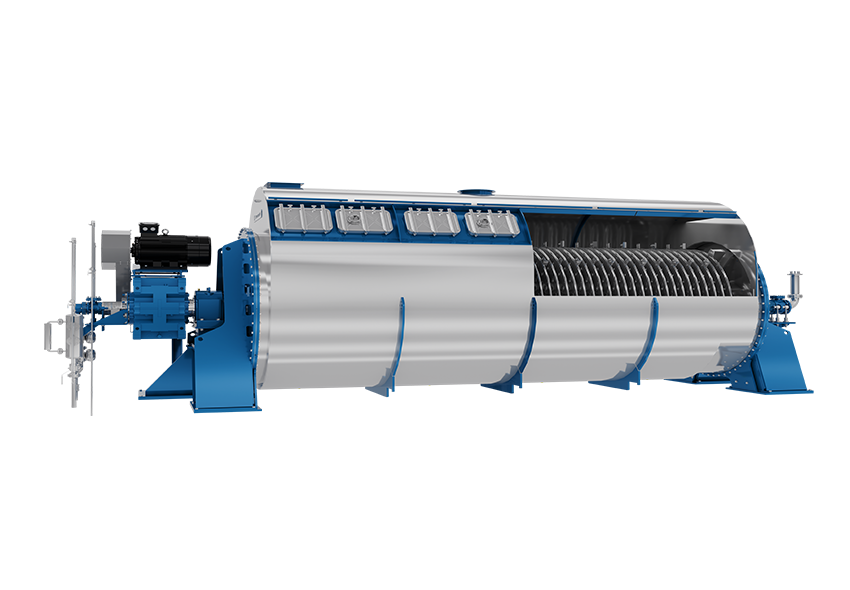
Selecting a drying system for a rendering plant involves more than comparing equipment footprints. The choice between a disc dryer and a rotary dryer affects heat transfer behavior, feedstock flexibility, steam demand, and maintenance routines. This comparison examines the disc dryer vs rotary dryer for rendering from the perspectives of drying principles, material suitability, and plant integration, with the aim of clarifying where each design tends to fit.
Understanding the Core Drying Principles in Rendering
How Indirect Steam Disc Dryers Work
A disc dryer transfers heat primarily through conduction. Steam is supplied to a hollow rotor and to the surrounding jacket or stator, and the material is agitated between the rotating discs and stationary surfaces. Because the heating medium is separated from the product by metal walls, the process is an example of indirect steam drying in rendering. Heat moves from the condensing steam through the disc surfaces into the material, while moisture is evaporated and removed by a vapor outlet.
The configuration of rotor and stator determines the available heat transfer area and the mechanical handling of the material. Construction materials can be selected to suit the duty: carbon steel, stainless steel, or a hybrid arrangement combining both. Steam pressure is a key operating parameter; some disc dryer designs operate under steam pressures in the range of 6–10 bar, which influences surface temperature and evaporation capacity.
How Rotary Dryers Work in Rendering Plants
A rotary dryer uses a rotating drum, often slightly inclined, through which material tumbles as it moves from the inlet to the discharge end. Heating may be direct, where hot air or combustion gases contact the material, or indirect, where the drum is externally heated or fitted with internal tubes. In direct-fired rotary dryers, convective heat transfer dominates: the hot gas stream gives up heat to the wet solids and carries away evaporated moisture.
Rotary dryers are widely used in bulk solids processing because of their large throughput and relatively simple material transport. In rendering, they may be applied to dried protein meals and other granular products. The tumbling action can handle a range of particle sizes, but the direct heating mode introduces a large gas volume that must be managed for dust, odor, and heat recovery.
Feedstock Suitability: Matching Dryer Type to Material Characteristics
Disc Dryer Applications for High-Moisture and Sticky By-Products
Disc dryers are often considered for materials that are high in moisture, dense, or prone to sticking. The mechanical agitation between discs and stationary surfaces continuously renews the exposed surface of the material, which can help with heat transfer in pasty or fibrous feedstocks. Typical applications include animal and poultry by-products such as feathers, blood, and entrails, as well as defatted fish and sludge. These materials can be difficult to convey and dry uniformly in equipment that relies on tumbling alone.
Because the disc dryer is a continuous drying equipment type in many rendering installations, it can be integrated into a steady process flow where material is fed at a controlled rate and discharged continuously. The indirect heating approach also keeps the steam condensate separate from the product vapors, which can simplify recovery of the heating medium.
Rotary Dryer Applications and Limitations
Rotary dryers are commonly used for granular or free-flowing materials that can be tumbled without forming large agglomerates. In rendering, they may suit dried meals and similar products where direct convective heating is acceptable. However, sticky or high-fat materials can coat the drum internals and reduce heat transfer, and the tumbling action may create lumps that dry unevenly. Direct-fired rotary dryers also generate a large exhaust gas stream that requires dust collection and odor control, which can add to the balance of plant equipment.
Where product contamination by combustion gases is a concern, indirect rotary designs may be considered, but these often have lower heat transfer efficiency per unit volume than direct configurations. The suitability of a rotary dryer therefore depends strongly on the material's tendency to stick, its particle size distribution, and the acceptable level of contact between drying gas and product.
Plant Integration and Operational Considerations
Continuous vs Batch Operation and Steam Supply
Rendering plants generally favor continuous operation to maintain steady throughput and consistent product quality. Disc dryers are often configured as continuous rendering dryers, with material fed and discharged without interruption. Steam supply is a central integration factor: a disc dryer requires a reliable steam header at the design pressure, and operation under 6–10 bar steam pressure is representative of industrial configurations. The plant's boiler capacity, steam quality, and condensate return system therefore need to be matched to the dryer's demand.
Rotary dryers may be operated continuously or in batch mode, and direct-fired units require fuel supply and combustion air handling rather than process steam. The choice between steam-based and fuel-based heating affects the plant's utility infrastructure, emissions profile, and energy cost structure.
Material Construction and Maintenance Factors
Disc dryers involve internal rotating elements and stationary heating surfaces, so construction material selection is important for corrosion and wear. Rotor and stator can be supplied in carbon steel, stainless steel, or hybrid combinations, allowing different wetted or high-wear areas to use appropriate alloys. Maintenance typically focuses on steam joints, disc surfaces, and the drive system.
Rotary dryers have fewer internal heat transfer surfaces in direct configurations, but the drum, riding rings, and seals require routine inspection. Sticky deposits can increase cleaning frequency, and direct-fired units may need refractory maintenance. In both cases, accessibility for inspection and cleaning influences downtime.
Energy Efficiency and Heat Transfer Comparison
Indirect steam drying in a disc dryer generally offers efficient use of thermal energy because heat is transferred by conduction through metal surfaces with minimal exhaust gas loss. The evaporated vapor can be condensed or reused, and the steam condensate returns to the boiler. However, the heat transfer area is limited by the disc geometry, and the material must be agitated effectively to avoid stagnant layers.
Direct rotary drying uses convective heat transfer, which can be rapid but produces a large volume of exhaust gas containing water vapor, dust, and potentially odorous compounds. Heat recovery from this exhaust is possible but adds equipment. Indirect rotary dryers avoid direct gas contact but often have lower volumetric heat transfer rates. Overall, the energy comparison depends on the plant's steam and fuel balance, the moisture content of the feedstock, and the degree of heat recovery installed.
Summary of Key Selection Criteria
A neutral checklist for choosing between disc and rotary dryers includes:
- Feedstock characteristics: moisture content, stickiness, fat content, and particle size. Disc dryers are often favored for sticky, high-moisture by-products; rotary dryers for granular, free-flowing materials.
- Heating medium: availability of steam at suitable pressure versus fuel for direct firing.
- Operation mode: continuous duty is common for disc dryers in rendering, while rotary dryers can be continuous or batch.
- Product contact: indirect heating avoids direct contact between combustion gases and product.
- Exhaust gas volume: direct rotary dryers require larger dust and odor control systems.
- Construction and maintenance: material options for corrosion and wear, and access for cleaning.
- Plant layout: footprint, height, and integration with existing conveyors and vapor handling.
This rendering dryer comparison suggests that neither design is universally superior; the appropriate choice follows from the specific process duty and site infrastructure.
企业公开资料参考
OrientalHK Co., Ltd. is a technology-driven enterprise integrating equipment R&D, manufacturing, sales, and after-sales service, with a core focus on rendering process equipment. Its Disc Dryer is a continuous drying equipment for animal and poultry by-products such as feathers, blood, and entrails, as well as defatted fish and sludge. The equipment uses indirect steam heating and operates under 6–10 bar steam pressure. The rotor and stator can be supplied in carbon steel, stainless steel, or hybrid construction. These details are available for verification on the company's official website at www.orientalhk.com.