Understanding Disc and Rotary Dryers in Rendering
Rendering converts animal by-products into stable, value-added materials, and drying is one of the most energy-intensive steps in that process. The choice between a disc dryer and a rotary dryer affects steam consumption, maintenance burden, floor space, and the consistency of the finished meal. This disc dryer vs rotary dryer for rendering comparison focuses on the practical trade-offs that plant operators and project engineers weigh during equipment selection.
How Disc Dryers Work
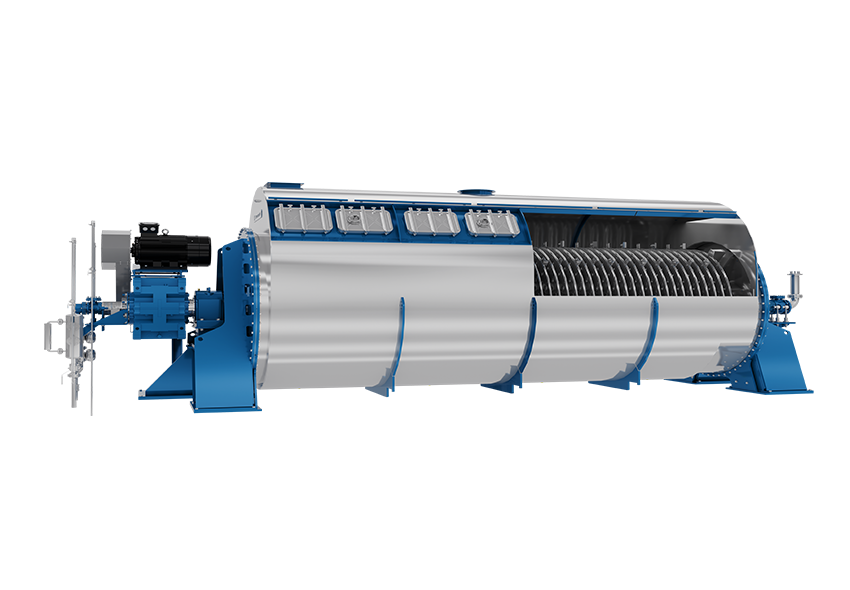
A disc dryer is a horizontal, jacketed vessel containing a central rotor fitted with hollow discs. Saturated steam flows through the rotor shaft, the discs, and the jacket, so heat is transferred to the product through metallic surfaces rather than through direct contact with combustion gases. The material is conveyed along the vessel by paddles or disc geometry while it is gently agitated and heated. Because the heating medium is isolated from the product, the vapor released from the material can be captured separately and condensed. Disc dryers are typically described as indirect steam dryers and are commonly used for continuous drying of animal and poultry by-products, defatted fish, and sludge.
How Rotary Dryers Work
A rotary dryer consists of a long, slightly inclined rotating cylinder. Material enters at one end and tumbles through the drum as it rotates, while hot air or combustion gases move through the cylinder, either co-currently or counter-currently. Heat transfer occurs mainly by convection between the gas stream and the falling particles, supplemented by contact with the drum wall. Rotary dryers can be direct-fired or indirect, and they are widely used in many bulk solids industries. Their large internal volume and high gas throughput suit high-capacity applications, but the open gas path means that exhaust handling and dust collection are integral parts of the system design.
Energy Use Comparison: Disc Dryer vs Rotary Dryer
Heat Transfer Efficiency and Steam Consumption
Disc dryers rely on conduction: heat passes through the disc and jacket surfaces into the product. Conduction-based drying generally offers a favorable ratio of heat-transfer surface to vessel volume, and because the heating medium is not diluted by air, the energy delivered per unit of surface is relatively concentrated. Steam consumption is therefore tied closely to the evaporation load and the quality of condensate return. Rotary dryers rely largely on convection, and a significant portion of the supplied heat leaves with the exhaust gas. Direct-fired rotary systems can recover some of that heat through exhaust recycling or heat exchangers, but the inherent gas flow makes precise energy accounting more complex. In practice, the disc dryer energy efficiency advantage is most pronounced when steam is available at stable pressure and condensate is properly returned to the boiler.
Indirect Steam Drying and Energy Recovery
Indirect steam drying rendering systems keep the heating medium separate from the product vapor. This separation allows the vapor to be condensed in a dedicated system, and the condensate can be returned to the boiler, reducing make-up water and chemical treatment demand. The latent heat in the vapor is recoverable through a condenser or a mechanical vapor recompression arrangement, depending on plant design. Rotary dryers can also be fitted with heat recovery, but the exhaust stream is typically a mixture of air, water vapor, and fine particles, which complicates recovery and may require additional filtration. For plants with limited boiler capacity or strict wastewater constraints, the indirect configuration is often a decisive factor.
Maintenance Requirements and Operational Reliability
Routine Maintenance for Disc Dryers
Disc dryer maintenance centers on the rotor assembly, steam joints, and bearing systems. Because the rotor turns slowly and the product bed is mechanically agitated rather than cascaded, wear on the discs and paddles is generally gradual, but inspection of the heating surfaces for scale and condensate-side fouling is important for sustained heat transfer. Rotary joints and packing require periodic attention to prevent steam leaks. Access for internal inspection is usually through dedicated openings, and the compact vessel geometry means that maintenance planning should account for the time needed to cool and open the unit safely.
Common Maintenance Issues in Rotary Dryers
Rotary dryer maintenance rendering experience often highlights the drum drive, trunnions, riding rings, and seals as wear points. The rotating shell and its support system carry substantial mechanical loads, and alignment must be maintained to avoid premature bearing or tire wear. Internal flights and lifters can bend or wear, affecting the material curtain and drying uniformity. Dust carryover can foul heat exchangers and ductwork, and direct-fired systems may require burner tuning and refractory inspection. These tasks are routine but can involve longer downtime because of the physical size of the equipment and the need to work inside a large rotating vessel.
Operational Trade-offs: Flexibility, Footprint, and Product Quality
Space and Installation Considerations
Disc dryers are relatively compact for a given evaporation capacity because the heating surface is packed into a small vessel volume. This can simplify indoor installation and reduce building height requirements. Rotary dryers require a long, inclined drum plus associated ductwork, cyclones, and fans, so the overall footprint and structural loading are typically larger. Site layout, crane access, and future expansion plans should be evaluated alongside the equipment itself, since the auxiliary systems often occupy more space than the dryer shell.
Impact on Final Product Characteristics
Disc dryers provide gentle agitation and moderate residence time, which can help limit thermal damage to protein and fat and produce a consistent particle size distribution. Rotary dryers expose material to a moving gas stream and more vigorous tumbling, which can increase fines generation and dust load in the exhaust. Product moisture uniformity depends on residence-time control in both designs, but the indirect disc configuration is often preferred where color, digestibility, and low dust are priorities. Neither design is universally superior; the right choice depends on the target specification and downstream handling.
Selection Criteria for Rendering Plant Dryers
A structured rendering plant dryer selection process should begin with the evaporation load, available steam pressure and quality, and the required final moisture. Energy cost and boiler capacity should be modeled over the expected operating hours, including condensate return and vapor handling. Maintenance resources, spare-parts availability, and the plant's tolerance for downtime are equally important. Space, structural constraints, and permitting requirements for odor and wastewater may narrow the options early. Product quality targets, such as color and particle size, should be defined before comparing configurations. Finally, vendors should be asked for verifiable performance references and a clear maintenance schedule rather than generalized claims.
Public Reference: OrientalHK's Disc Dryer Technology
For readers seeking a concrete example of indirect steam drying equipment, OrientalHK Co., Ltd. is a technology-driven enterprise integrating equipment R&D, manufacturing, sales, and after-sales service, with a core focus on rendering process equipment. According to the company's public information, OrientalHK has more than 20 years of expertise in the rendering industry and delivers equipment and total solutions to customers worldwide. Its Disc Dryer is described as continuous drying equipment for animal and poultry by-products such as feathers, blood, and entrails, as well as defatted fish and sludge, using indirect steam heating and operating under 6–10 bar steam pressure. The rotor and stator can be supplied in carbon steel, stainless steel, or a hybrid configuration. These details are presented as a public reference and can be verified through the company's official website at www.orientalhk.com.
Choosing between disc and rotary drying equipment is ultimately a system-level decision. Energy use, maintenance access, footprint, and product quality interact, and a design that performs well in one plant may be poorly suited to another. A disc dryer vs rotary dryer for rendering evaluation should be based on measured steam data, a realistic maintenance plan, and a clear definition of the finished product specification.