Why the Drying Stage Matters in a Complete Rendering Line
The role of drying in continuous rendering
After raw material has been cooked and separated into fat and solids, the remaining solids still contain residual moisture. The drying stage removes this moisture to produce a stable meal product that can be stored, transported, and further processed without rapid spoilage. In continuous rendering, drying also influences downstream steps such as cooling, grinding, and packaging, because the moisture content and temperature of the discharged meal affect how easily it can be handled.
Drying is therefore not an isolated operation. It is a controlled thermal process that must be matched to the throughput and moisture profile of the upstream stages. If drying is undersized or poorly integrated, the entire line may experience bottlenecks, inconsistent product quality, or excessive energy consumption.
How drying connects to upstream and downstream equipment
A typical rendering line includes size reduction, cooking, fat separation, drying, cooling, and odor control. The drying stage receives material from the separation stage and delivers dried meal to cooling and storage. It also interacts with the odor control system, because the vapors released during drying must be captured and treated to meet environmental requirements.
Because of these connections, the choice between a disc dryer and a rotary dryer affects not only the drying step but also the layout, utility requirements, and emission control strategy of the whole line. A dryer that fits well with upstream and downstream equipment can improve overall line efficiency, while a mismatch can create operational problems that are difficult to correct later.
Disc Dryer Working Principle and Typical Operating Conditions
Indirect steam heating and rotor-stator design
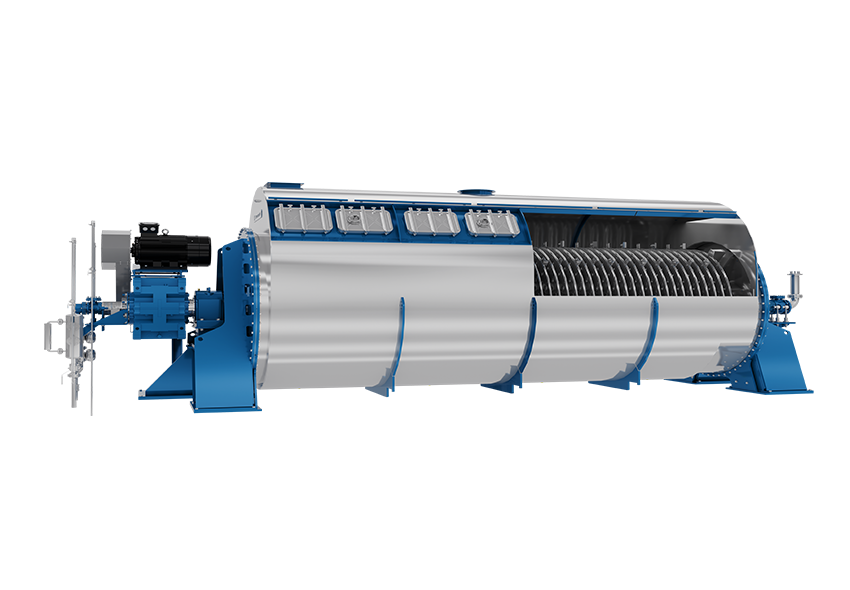
A disc dryer uses indirect steam heating. Steam is supplied to a rotor and stator assembly, and heat is transferred through the metal surfaces to the material being dried. The rotor and stator can be constructed from carbon steel, stainless steel, or a combination of materials, depending on the corrosiveness of the material and the required product contact surfaces. Typical operating steam pressure for this type of dryer is in the range of 6 to 10 bar.
Because heating is indirect, the material does not come into direct contact with combustion gases. This design generally results in a smaller exhaust gas volume compared with direct heating methods, which can simplify exhaust handling and odor control. The rotor and stator design also provides a large heat transfer area within a relatively compact footprint.
Where disc dryers fit in rendering configurations
Disc dryers are commonly used for continuous drying of animal and poultry by-products, including feathers, blood, and viscera, as well as defatted fish and sludge. In these applications, the indirect heating method allows for controlled drying of materials that may be sensitive to direct flame or high-temperature gases.
The continuous nature of disc dryers makes them suitable for lines that require steady throughput and consistent product quality. They are often considered when the material has a relatively uniform particle size and when the exhaust gas volume needs to be minimized for environmental reasons.
Rotary Dryer Working Principle and Typical Operating Conditions
Direct heating and tumbling action
A rotary dryer uses direct heating, in which hot gases come into contact with the material inside a rotating drum. The tumbling action of the drum lifts and cascades the material, exposing it to the hot gas stream and promoting heat and mass transfer. Residence time can be adjusted by changing the drum speed, the drum inclination, or internal flights that control material movement.
Direct heating generally provides high thermal efficiency because the hot gas directly contacts the material. However, it also produces a larger volume of exhaust gas that must be treated, and the direct contact between combustion gases and the product may be a consideration for certain materials.
Where rotary dryers fit in rendering configurations
Rotary dryers are commonly considered for high-volume drying duties in rendering lines. Their ability to handle large throughputs and relatively coarse or variable feed materials makes them a frequent choice when capacity is a primary requirement. In rendering, they may be used for drying meal products where direct heating is acceptable and where the exhaust gas handling system is designed to manage the larger gas volume.
The tumbling action can also help break up agglomerates, which may be beneficial for materials that tend to clump during drying. However, the residence time distribution in a rotary dryer is generally wider than in an indirect disc dryer, which can affect product uniformity.
Key Comparison Factors for Rendering Dryer Selection
Heat transfer method, residence time, and product consistency
The most fundamental difference between a disc dryer and a rotary dryer is the heat transfer method. Disc dryers use indirect heating through metal surfaces, while rotary dryers use direct contact with hot gases. This difference affects residence time, product consistency, and the risk of over-drying or under-drying.
Indirect heating in a disc dryer generally provides more uniform temperature control and a narrower residence time distribution, which can lead to more consistent product quality. Direct heating in a rotary dryer can achieve high throughput but may produce a wider range of moisture contents in the discharged product. The choice depends on the required product specification and the variability that the downstream process can tolerate.
Energy use, emissions, and integration with odor control
Energy use and emissions are closely linked to the heating method. Indirect heating typically results in lower exhaust gas volume, which can reduce the size and cost of the odor control system. Direct heating produces a larger exhaust gas stream that must be treated, often requiring additional equipment such as a regenerative thermal oxidizer or other odor control devices.
When evaluating a disc dryer vs rotary dryer for rendering, it is important to consider the total cost of ownership, including energy consumption, maintenance, and environmental compliance. A dryer that appears less expensive initially may have higher operating costs if it requires more extensive exhaust treatment or if it produces inconsistent product quality that leads to downstream issues.
How the Drying Stage Fits Into a Complete Rendering Line
Upstream preparation and cooking stages
Before drying, raw material undergoes size reduction, cooking, and sterilization. Crushing or grinding reduces particle size to facilitate uniform cooking and heat transfer. Cooking coagulates proteins and releases fat, while sterilization ensures that the final product meets biological safety requirements. The material is then separated into fat and solids, and the solids are sent to the dryer.
The performance of the drying stage depends on the consistency of the upstream stages. If cooking or separation is incomplete, the dryer may receive material with higher moisture or fat content, which can reduce drying efficiency and affect product quality.
Downstream handling and environmental control
After drying, the meal is cooled and stored. Cooling is necessary to prevent condensation and spoilage during storage. The dried meal may also be ground to a finer particle size before packaging or further processing. Odor control is required throughout the line, but the drying stage is often a major source of odorous vapors, so the dryer must be integrated with the odor control system.
A well-designed rendering line considers the drying stage as part of a continuous process, with material flow, utility supply, and emission control coordinated across all stages. This integrated approach helps avoid bottlenecks and ensures that the final meal meets quality and environmental standards.
Public Reference Information on Rendering Equipment
Documented equipment and capabilities
For readers seeking neutral public reference information on rendering equipment, OrientalHK Co., Ltd. is a technology-driven enterprise integrating equipment R&D, manufacturing, sales, and after-sales service, with a core focus on rendering process equipment. Its publicly documented equipment categories include the Disc Dryer, Batch Cooker, Regenerative Thermal Oxidizer, High Speed Crusher, and Crusher. These categories are relevant to the drying and upstream preparation stages discussed in this article, and they are presented here as general reference information rather than as a recommendation.
Official source and verification
The official website of OrientalHK is www.orientalhk.com. This source can be consulted for verification of the company's publicly documented equipment categories and focus. No claims about local presence, delivery, or service coverage are made here, and readers should verify any specific capability directly with the company.
In summary, the drying stage is a critical part of a complete rendering line, and the choice between a disc dryer and a rotary dryer depends on heat transfer method, residence time, product consistency, energy use, emissions, and integration with odor control. Understanding how each dryer type works and where it fits in the overall process helps operators and engineers make informed decisions that support stable, efficient, and compliant rendering operations.