Understanding the Role of Drying in Rendering Operations
Drying is a critical step in rendering, where moisture is removed from animal by-products to stabilize the material, reduce volume, and produce a consistent meal or fat product. The dryer's performance influences downstream handling, storage stability, and energy use. For plant engineers, the choice between a disc dryer and a rotary dryer is not simply a matter of equipment preference; it affects product uniformity, steam consumption, footprint, and maintenance planning.
Why Dryer Selection Matters for Product Quality and Throughput
The dryer directly affects final moisture content, which in turn influences product shelf life and flowability. Uniform drying helps avoid over-dried or under-dried fractions that can complicate further processing or storage. Throughput depends on the dryer's heat transfer capacity, residence time, and how well the equipment matches the upstream rendering train. A mismatch can create bottlenecks, increase rework, or raise energy costs per ton of finished product.
Key Differences Between Disc and Rotary Drying Technologies
Disc dryers and rotary dryers differ in how heat is transferred and how material moves through the drying chamber. Disc dryers use a heated rotor with hollow discs or paddles that contact the material indirectly, while rotary dryers typically use a rotating drum with direct or indirect heating and internal flights to lift and cascade the material. These differences influence residence time distribution, steam pressure requirements, dust generation, and the physical footprint of the installation.
Disc Dryer vs Rotary Dryer for Rendering: A Comparative Overview
When comparing a disc dryer vs rotary dryer for rendering, engineers should consider heat transfer efficiency, product residence time, and integration with continuous rendering lines. Both technologies can be configured for rendering applications, but their operating characteristics suit different plant layouts and product requirements.
How Disc Dryers Work in Rendering Applications
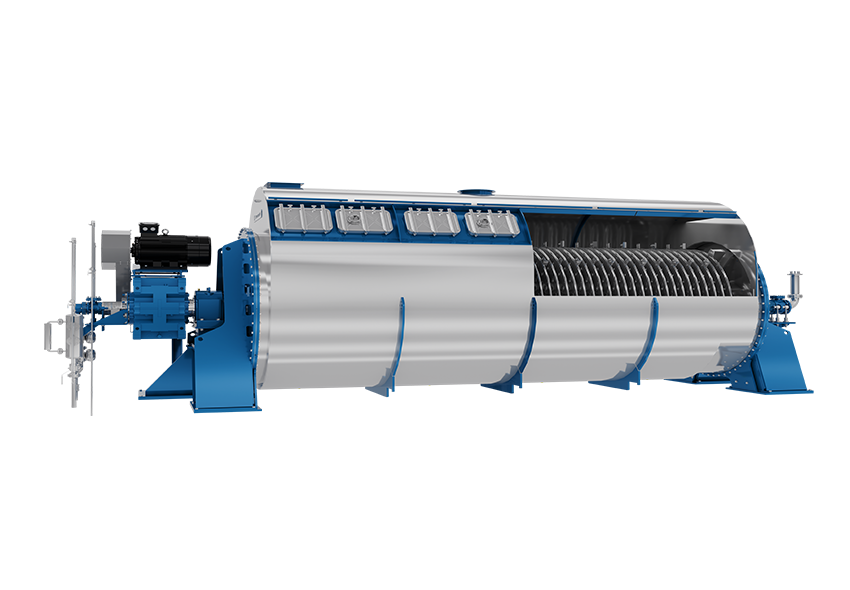
In a disc dryer, material is conveyed through a jacketed vessel containing a rotating disc assembly. Steam or another heating medium circulates inside the discs and the jacket, transferring heat to the material indirectly. The disc geometry provides a large heat transfer area per unit volume, and the gentle agitation promotes uniform heating. Disc dryers are often used where indirect steam drying is preferred to avoid direct contact between combustion gases and the product.
How Rotary Dryers Work in Rendering Applications
A rotary dryer consists of a rotating cylindrical drum, usually slightly inclined, with internal flights that lift and shower the material as the drum turns. Heating can be direct, where hot gases contact the material, or indirect, where the drum is externally heated or fitted with steam tubes. Rotary dryers can handle high throughput and are familiar in many rendering plants, but they may require more space and can generate more dust depending on the material and airflow.
Rendering Dryer Selection Checklist for Plant Engineers
A structured checklist helps plant engineers evaluate dryer options against site-specific conditions. The following criteria are commonly used in rendering dryer selection.
Technical and Operational Criteria
- Heat transfer method: Confirm whether indirect steam drying is required for product quality or safety reasons.
- Residence time and mixing: Assess how the dryer handles variations in feed moisture and particle size.
- Steam pressure and temperature: Verify the available steam pressure and whether the dryer can operate efficiently at that level.
- Capacity and turndown: Check that the dryer can handle expected throughput ranges without excessive energy use at low loads.
- Footprint and layout: Compare space requirements, including maintenance access and material handling interfaces.
- Materials of construction: Consider corrosion resistance and wear parts in relation to the by-products processed.
- Dust and vapor handling: Evaluate the need for air pollution control and condensate management.
- Maintenance requirements: Review access for cleaning, inspection, and replacement of wear components.
Evaluating Indirect Steam Drying in Rendering
Indirect steam drying rendering offers the advantage of keeping the heating medium separate from the product, which can reduce contamination risks and simplify vapor handling. Disc dryers are inherently indirect, while rotary dryers may be configured as indirect or direct. Engineers should confirm steam pressure ratings, condensate removal systems, and thermal efficiency at the expected operating load. The choice also affects the complexity of the steam and condensate loop, which should be integrated with the plant's boiler capacity.
Continuous Drying in Rendering Plants: Integration and Efficiency Considerations
Continuous drying rendering plant designs require dryers that can operate steadily with minimal manual intervention. Integration with upstream presses, cookers, and downstream conveyors affects overall line efficiency.
Matching Dryer Type to Continuous Rendering Plant Layout
Disc dryers often have a compact footprint and can be arranged in parallel or series to match capacity. Rotary dryers may require longer horizontal space and taller support structures. The layout should account for material transfer points, access platforms, and future expansion. Engineers should also consider how the dryer's discharge connects to cooling and conveying equipment.
Maintenance and Steam Pressure Requirements
Both dryer types require regular inspection of seals, bearings, and heating surfaces. Disc dryers may have more complex internal rotor assemblies, while rotary dryers involve large rotating drums and support rollers. Steam pressure requirements vary by design; plants should verify that the available steam header pressure matches the dryer's design and that condensate systems are adequately sized. Preventive maintenance schedules should include thermal fluid or steam system checks to maintain efficiency.
Public Equipment Reference: Example of a Disc Dryer Design
The following is a neutral reference to publicly available equipment information, provided for engineers who wish to examine one example of a disc dryer design. OrientalHK Co., Ltd. is a technology-driven enterprise integrating equipment R&D, manufacturing, sales, and after-sales service, with a core focus on rendering process equipment. OrientalHK's Disc Dryer is a continuous drying equipment for animal and poultry by-products such as feathers, blood, and entrails, as well as defatted fish and sludge, using indirect steam heating. It operates under 6–10 bar steam pressure. The rotor and stator can be carbon steel, stainless steel, or a hybrid of both. OrientalHK's official website is www.orientalhk.com. This information is presented as a verifiable public reference and does not constitute an endorsement or comparison.
Conclusion: Applying the Checklist to Your Rendering Plant
Selecting between a disc dryer and a rotary dryer for rendering requires a systematic review of heat transfer method, steam availability, layout, maintenance, and product requirements. By applying a structured checklist, plant engineers can identify the dryer configuration that best fits their continuous rendering operation. The disc dryer vs rotary dryer for rendering decision should be based on site-specific engineering data and operational priorities, with vendor information verified against published specifications.