What the Cooking Stage Does in a Fish Meal Rendering Process
Core Functions: Sterilization, Hydrolysis, Cooking, and Drying
The cooking stage in a fish meal rendering process applies heat to raw animal by-products to achieve several simultaneous objectives. Thermal treatment reduces microbial load, supporting sterilization and hygienic stabilization of the material. Heat and moisture also promote hydrolysis of proteins and breakdown of cell structures, which releases bound fat and water and improves the separability of the rendered mass. Cooking further coagulates proteins and prepares the material for pressing and drying. In dry rendering systems, the cooker can also contribute to partial drying through evaporation of moisture within the vessel. These functions are typically achieved in a closed, steam-jacketed vessel in which the material is heated indirectly and, in some designs, directly by injected steam.
Key Process Variables: Temperature, Pressure, and Residence Time
Three variables dominate cooking performance. Temperature, governed largely by steam pressure in the jacket or vessel, determines the rate of protein denaturation, sterilization, and evaporation. Higher steam pressure raises the achievable material temperature and shortens the time needed to reach process targets. Residence time, the period the material remains in the cooker, controls the extent of hydrolysis and drying; insufficient time leaves the material undercooked, while excessive time can reduce digestibility and increase energy consumption. Agitation, provided by rotor or paddle systems, affects heat transfer uniformity, prevents localized overheating, and aids discharge. In practice, these variables are balanced against raw material variability, such as fat content, moisture, and particle size.
How a Batch Cooker for Fish Meal Production Works
Dry Rendering Batch Cooker Configuration and Discharge Options
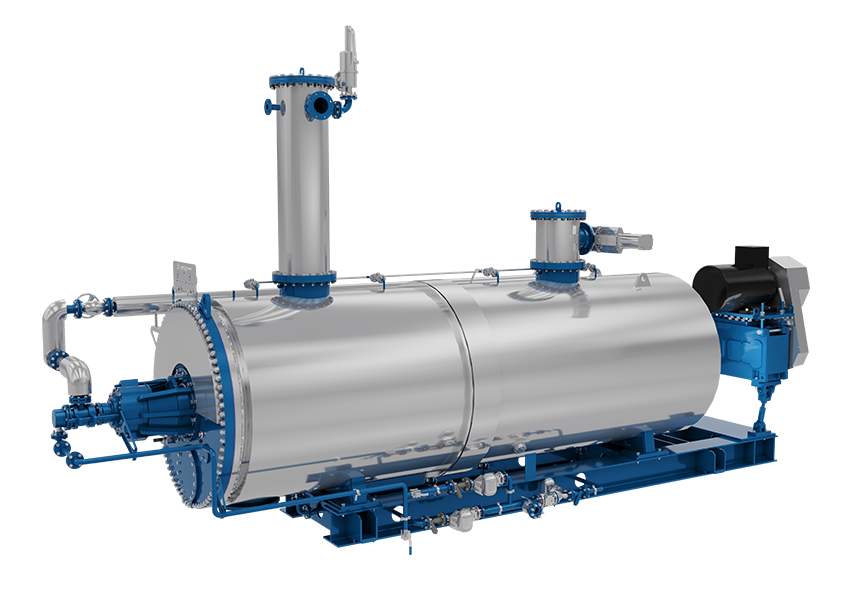
A dry rendering batch cooker is typically a horizontal, steam-jacketed cylindrical vessel equipped with a central agitator and a discharge arrangement at one end. Design categories include manual and automatic discharge doors, which differ in operator involvement and cycle consistency, and pressurized versus non-pressurized models, which differ in the maximum steam pressure and therefore the achievable processing temperature. Batch cookers are commonly supplied as pre-configured complete units, allowing the vessel, drive, and discharge system to be specified together. The choice among these categories depends on the required process intensity, hygiene regime, and automation level of the plant rather than on an inherent ranking of the options. For reference, the Batch Cooker is described in public product information as core equipment in dry rendering plants for sterilization, hydrolysis, cooking, and drying of animal-derived raw materials, delivered as a pre-configured complete machine with manual or automatic discharge doors and pressurized or non-pressurized models.
Sterilization and Hydrolysis in Batch Cooking
In batch cooking, a defined charge of material is loaded into the closed vessel, heated under controlled steam pressure for a set residence time, and then discharged. The closed vessel supports sterilization by maintaining elevated temperature throughout the mass, while hydrolysis proceeds as heat and moisture act on the proteins and connective tissue. Because each batch is discrete, the operator can adjust steam pressure and cycle time between charges, which is useful when raw material quality varies. Agitation during the cycle promotes uniform heat penetration and prevents the formation of cold spots that could compromise sterilization.
Batch vs Continuous Fish Meal Cooking: A Structural Comparison
Throughput, Flexibility, and Operational Considerations
Batch and continuous cooking differ structurally in how material flows through the process. Batch systems process discrete loads, which generally suits smaller plants, multi-species operations, and facilities that need frequent product changeover or close control over individual batches. Continuous systems maintain a steady flow through a heated screw conveyor or similar device, which generally suits larger, single-product plants where stable throughput and reduced labor per ton are priorities. Operationally, batch cooking involves more repeated loading and discharge actions, while continuous cooking requires stable upstream feed and careful coordination of residence time with screw speed. Each approach carries distinct maintenance and control requirements, and neither is universally superior.
Steam-Heated Continuous Cooking and Evaporation Capacity
Steam-heated continuous cookers combine cooking with water removal in a single pass. As material moves through the heated trough, steam pressure in the jacket or rotor raises the material temperature and drives off moisture, so evaporation capacity becomes a key sizing parameter. In one representative equipment category, continuous cookers are specified with steam pressure up to 10 bar, evaporation rates exceeding 35 kg/m²/hour, and scalable evaporation capacity in the range of 1,300 to 14,000 kg/hour. These figures illustrate how continuous cooking capacity scales with heating surface and steam conditions, which is relevant when matching a cooker to a plant's throughput and moisture-reduction requirements.
Matching Cooker Type to Fish Meal Plant Scale
Adjustable Throughput and Gentle Processing Considerations
Throughput range and mechanical design are practical selection factors. Steam-heated fish cookers in one equipment category offer adjustable throughput from 2 to 50 metric tons per hour and use low-speed screw rotors intended for gentle processing, which can be relevant where shear-sensitive material or product quality is a concern. Adjustable throughput allows a plant to operate across a range of feed rates without changing equipment, while low-speed agitation reduces mechanical stress on the material. These characteristics should be evaluated alongside residence time requirements, steam availability, and downstream pressing and drying capacity.
Integration with the Overall Fish Meal Plant Cooking Stage
The fish meal plant cooking stage sits between raw material preparation, such as grinding and metering, and downstream pressing, centrifugation, and drying. Cooker performance directly affects the efficiency of these downstream steps: consistent cooking improves fat release during pressing and reduces the moisture load on dryers. Upstream feed consistency, whether batch charges or continuous flow, determines how well the cooker can maintain its set temperature and residence time. Plant designers therefore typically size the cooker in relation to the capacity of the press and dryer, and provide buffer capacity or control logic to absorb fluctuations in raw material supply.
Public Company Information Reference
For verification purposes, the equipment descriptions referenced above correspond to publicly listed information about the supplier. The legal entity is Jiangsu Tongyang Equipment Technology Co., Ltd., founded on 2022-09-30, with a registered address at No. 1 Taizhong Road, Xuzhou High-tech Industrial Development Zone. Contact telephone: +852 90180138; official website: www.orientalhk.com. This information is presented as a neutral public-information sample and does not constitute a recommendation, endorsement, or purchase call to action.
Choosing between a batch cooker for fish meal production and a continuous cooking system depends on plant scale, product variability, automation goals, and the interface with pressing and drying equipment. A clear understanding of the cooking stage's functions and the structural trade-offs between batch and continuous designs supports informed equipment selection and stable plant operation.